Astronomy of Three Sacred Nights of Devi
Across India, there is an ancient tradition of honoring the Divine Feminine — Devi — through three special nights (Rātri) observed at different points in the lunar year. Remarkably, these observances have remained largely unchanged across centuries. Each night highlights a distinct cosmic aspect of Devi expressed through Māyā — the mysterious force that binds, governs, and ultimately liberates existence.
Moha Rātri – The Night of Delusion
(Full Moon in Phālguna — Spring)
Moha means delusion, attraction, attachment. Individual ego survives only because the mind is held captive by Devi’s power of Māyā. Recognizing this veil of delusion becomes the first step in awakening.
The Holi full moon marks Moha Rātri — a reminder of how the cosmic play of Māyā enchants all beings.
The three nights celebrate different aspects of Devi as Maya. Firstly, the night of Moha Ratri (the night of Delusion principle) is the full moon night in spring (Lunar month of Phalgun). Secondly, Kala Ratri (the night of Time principle) falls, smack in the middle, of the bright fortnight at the beginning of fall (Lunar month of Ashwin). Thirdly, Maha Ratri (Great Night), is the new moon night at the end of fall (Lunar month of Karthik).
Kāla Rātri – The Night of Time
(Seventh lunar day during the bright fortnight of Āshwin — early autumn)
Kāla is Time, the devourer of all things. Kāla Rātri represents the fearsome, secret, and uncompromising face of Devi — the force that dissolves limitation and illusion.
Falling exactly at the midpoint of the lunar fortnight, Kāla Rātri signals the crossing from form to formlessness. Worship on this night occurs during Navarātri, when seekers invoke the Devi who cuts through intellectual entanglement and restores inner clarity.
Mahā Rātri – The Great Night
(New Moon in Kārttika — late autumn / Deepāvali night)
Mahā Rātri coincides with Deepāvali, the festival of lights. Just as a lamp dispels outer darkness, Mahā Rātri signifies the inner light that destroys ignorance. This night celebrates Devi as the supreme radiance from which all knowledge arises.
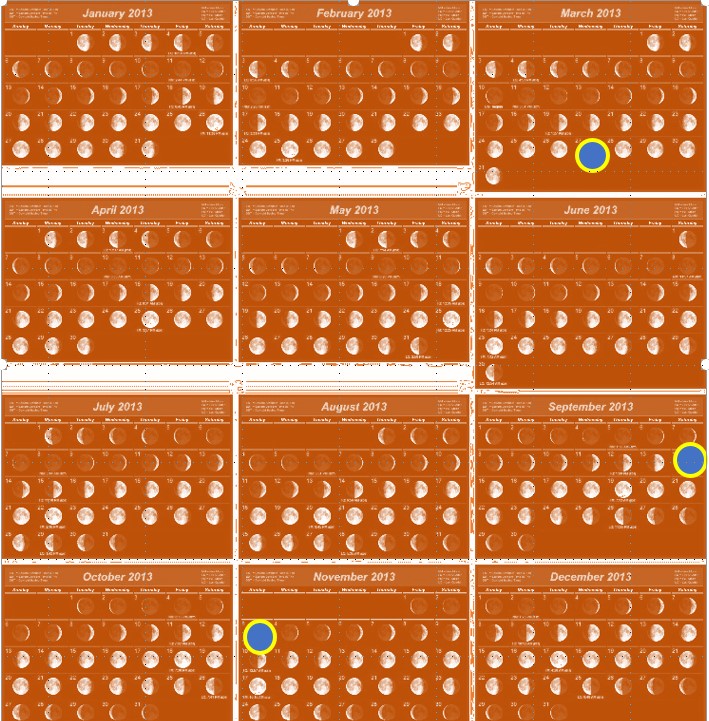
Astronomical Harmony
These three nights are not merely symbolic — they are astronomically synchronized.
- A lunar month is ~29 days long.
- Each fortnight spans ~14–15 days.
- The midpoint falls between the 7th and 8th day — exactly where Kāla Rātri is placed.
- The new moon of Āshwin (Kāla Rātri cycle) sits directly opposite the full moon of Phālguna (Moha Rātri) — about 180° apart in the sky.
- Mahā Rātri completes the triad at the end of the autumnal cycle, sealing the inward journey from delusion → time → illumination.
In Essence
| Night | Meaning | Lunar Timing |
|---|---|---|
| Moha Rātri | Delusion (Māyā) | Full Moon – Phālguna |
| Kāla Rātri | Time / Dissolution | Midpoint of bright fortnight – Āshwin |
| Mahā Rātri | Illumination | New Moon – Kārttika |
These three Rātris together celebrate Devi as Māyā — the cosmic force that veils, tests, transforms, and finally liberates.
Thus, the three sacred nights are not only spiritual observances, but also reflect a hidden astronomical symmetry encoded in the movement of Sun and Moon.
A verse from Rudra Yāmala Tantra summarizes how Maya dissolves in three phases into Shiva. Ignorance dissolves with Moha Ratri. The aspect of time related to Karma dissolves with Kala Ratri. Ideation related to Name-Form dissolves with Maha Ratri.
“kālā rātrir moharātrir mahārātriḥ prakīrtitāḥ
tisro’py etā mahāmāyāḥ śivāveśe layaṃ gatāḥ”
